Information

Trucking companies are important part of supply chains, as they connect most of product movements. While a lot of studies have been done to assess supply chain maturity level, very limited studies have been done to specifically address trucking companies. In this study we develop a model and measurement instruments to assess maturity of trucking companies in terms of their innovative capabilities. Innovative capabilities are critical in today's fast technological development such as industry 4.0 and trucking companies have opportunities to use those technologies to play a better role in the supply chain they involve in. We then use the instruments to assess the maturity level of 52 companies that involved in transporting goods using trucks. The results show that the maturity level has a widespread, ranging from the lowest to the highest level, but most of them are in the category of partial maturity to mature. This indicates that most companies have an opportunity to improve their innovative capabilities.
1. Introduction
Transportation is an important and inseparable part of logistics and supply chain activities. Trucking companies play an important role in the delivery of goods on land and connecting other modes of transportation. The trucking industry is characterized by high competition, large players, and relatively limited innovation. With the recent technological development, trucking companies have ample opportunities to improve their services and playing better roles in the supply chains.
Industry 4.0 is growing rapidly today, and as a result, trucking companies are also required to follow the trend to improve their services (Strandhagen et al., Citation2017 ). These additional services include online booking, real-time delivery information, system connectivity with customers, and many others (Oleśków-Szłapka & Stachowiak, Citation2018 ). It requires trucking companies to continue to innovate to keep up with the changes. To continue to innovate, trucking companies must have innovative capabilities. The innovative capability is the company’s ability to make changes, adapt and implement knowledge into something new and is carried out continuously in order to achieve the company’s strategic goals through innovative actions and processes (Hurley & Hult, Citation1998 ; Lawson & Samson, Citation2001 ; Wang & Ahmed, Citation2004 ; Yang, Citation2012 ).
The innovative capability of trucking companies in this study is influenced by technological capabilities, market orientation, and supplier relationships. The three factors above play an important role in increasing the trucking company’s innovative capability. For this reason, it is critical to review and assess the readiness and maturity of a trucking company’s innovative capabilities. There is less research on the innovative capability for the service industry than for the manufacturing industry. Moreover, research that focuses on the innovative capability of trucking companies is also rare, especially those that examine the maturity level of the innovative capability in trucking companies. This assessment is useful for mapping the maturity level of the trucking company’s innovative capability based on the three factors above, to then be used in determining the next strategic step (Proença & Borbinha, Citation2016 ). The data obtained plays an important role in knowing industry developments in identifying gaps to ensure success and assist companies in maintaining their status as market leaders (Antunes et al., Citation2014 ). This study aims to assess the maturity level of trucking companies’ innovative capability in Indonesia to compare their implementation in the field with the strategies of companies and others (Röglinger et al., Citation2012 ; Zhang et al., Citation2017 ).
This study uses the capability maturity model as an instrument to assess the maturity level of trucking companies’ innovative capability and adopt related measures (Y. C. Chen & Wang, Citation2018 ). The superiority of this model has been confirmed by various studies (Appleby & Mavin, Citation2000 ; Delaney & Huselid, Citation1996 ; Huselid, Citation1995 ). The framework will assist companies in prioritising the capabilities on which they should focus. Companies can critically evaluate the components of their innovative capability to help them become competitive. This study focuses on trucking companies in Indonesia to assess maturity levels. The research questions for this study are as follows.
RQ 1: What is the maturity level of a trucking company’s innovative capability? To what extent is the maturity level of this trucking company’s innovative capability influenced by such determinants as the maturity level of technological capability, market orientation and supplier relations?
RQ 2: Do trucking companies in various industries have the same level of maturity in their innovative capability? Does the company’s size, whether based on truck units owned or annual revenue, affect the maturity level of a trucking company’s innovative capability? Are the determinants of the maturity level of a trucking company’s innovative capability different in the above groupings?
This research is structured as follows. Part 2 contains a review of the literature on innovative capability, the components of innovative capability and an explanation of the maturity model in the context of a trucking company. Section 3 presents an empirical research design using data on 52 trucking companies in Indonesia. Section 4 discusses the results obtained. In addition, we also analysed the groups and compared the results with one another. Section 5 is the discussion, and section 6 offers concluding comments, limitations of the study, and suggestions for future research and strategies to overcome these limitations.
2. Literature review
2.1. Innovative capability
The innovative capability is the entire ability of a company to change, adapt and implement ideas and knowledge (processes, systems, products, services, and many others) into something new and carried out continuously for the company’s strategic interests through innovative behaviour and processes (Hurley & Hult, Citation1998 ; Lawson & Samson, Citation2001 ; Wang & Ahmed, Citation2004 ; Shou et al., 2016; Yang, Citation2012 ). This innovative capability influences the success and sustainability of the company (Cardozo et al., Citation1993 ; Lai et al., Citation2015 ).
Trucking companies are an important part of the supply chain. Factors that influence the innovative capability in the supply chain in previous research, among others, are competence, flexibility, responsiveness (Ferrer et al., Citation2011 ), collaboration (Swink, Citation2006 ), network contribution (Delbufalo, Citation2015 ), and big data (Tan et al., Citation2015 ). Innovative capability in the logistics sector positively impacts performance (Grawe et al., Citation2011 ; Ho & Chang, Citation2015 ; Kafetzopoulos & Psomas, Citation2015 ). ideally, logistics companies focus more on providing better services to customers (Wang et al., Citation2020 ). Just-in-time systems result from the logistics sector’s innovative capability, saving on warehouse space and reducing overall costs (Wei et al., Citation2018 ). As part of the supply chain and logistics, trucking companies must also develop their innovative capabilities to improve their performance. In this research, the innovative capability of trucking companies consists of technological capabilities, market orientation and supplier relationship. The components will be discussed in the following sub-sections.
2.2. Innovative capability components
2.2.1. Technological capability
Technological capabilities are the current capabilities and future potential to apply specific technologies, solve technical problems, or improve technical functions (Lefebvre & Lefebvre, Citation2002 ; Nicholls-Nixon, Citation1995 ). Technological capability is an attempt by a company to change or improve the quality of products and processes, with the creation of knowledge, technical capabilities and the integration of new, more advanced components (Kyläheiko et al., Citation2011 ; Quintana-García & Benavides-Velasco, Citation2008 ; Radosevic & Yoruk, Citation2016 ).
Technological capabilities are the driving force for innovation in companies (Hsieh & Tsai, Citation2007 ). Technological capabilities are the foundation for companies to build capabilities and processes to innovate (the innovative capability; Eng & Okten, Citation2011 ). Innovative capability is the ability to create new technologies, product or process features and designs, and develop company ideas (Bell & Figueiredo, Citation2012 ). Technological capabilities support the formation of this capability because technological capabilities also include the ability to conduct research and development (Radosevic & Yoruk, Citation2016 ). This ability plays two roles: the ability to absorb knowledge from outside the company and carry out leading-edge technology (Szalavetz, Citation2019 ). Technological capabilities play an important role in increasing the trucking company’s innovative capability. Currently, digital transformation and the use of advanced technology are increasing along with the progress of the times. The progress of the times is closely related to the use of technology, so that ability in this field is important.
2.2.2. Market orientation
Market orientation is the company’s philosophy always to meet customer needs (Aziz & Omar, Citation2013 ). Market orientation is a response to and commitment to customer needs and wants. It is done by creating better value than competitors by coordinating activities to achieve customer satisfaction (Narver & Slater, Citation1990 ; Ruekert, Citation1992 ). Market orientation is a company marketing concept that puts the customer at the centre of the company’s strategic thinking and operations (Keskin, Citation2006 ). It is done by analysing market information (Aziz & Omar, Citation2013 ). Market orientation must align with the company’s strategy because it directly impacts technology choice and product development (Conant et al., Citation1990 ; McKee et al., Citation1989 ). High market orientation gives birth to processes, behaviours, and skills reflected in the company’s culture in meeting customer satisfaction and paying attention to the responses and capabilities of competitors (Prasad et al., Citation2001 ).
Market orientation has three related parts: customer orientation, competitor orientation, and coordination between functions (Mukhtar Shehu & Mahmood, Citation2014 ; Narver & Slater, Citation1990 ). Customer orientation continuously communicates and defends customer needs (Han et al., Citation1998 ). Customer orientation is a major factor because creating superior value is carried out for customers (McNaughton et al., Citation2002 ). Competitor orientation is a company’s effort to predict its strengths and weaknesses in the short and long term to provide better customer service than competitors (Huhtala et al., Citation2014 ). The last is coordination between company functions individually and in departments to synergise and collaborate to achieve company goals (Zehir et al., Citation2015 ).
In this study, the trucking company’s market orientation focuses on two aspects of market orientation, namely customer orientation and competitor orientation. Customer-oriented companies continuously and consistently innovate to meet the needs and retain their main customers (Chaudhry et al., Citation2019 ). Amid intense competition, innovative companies focus on the current market and try to meet customers’ needs in the future (Hortinha et al., Citation2011 ). Customer-oriented companies tend to develop innovative capabilities. It is intended to make companies more innovative and responsive to customer needs (Chaudhry et al., Citation2019 ). Customer orientation positively correlates with innovative capability (Appiah-Adu & Singh, Citation1998 ; Grinstein, Citation2008 ). Competitor orientation is a source for organisational learning, which can develop innovative capabilities specifically (Lisboa et al., Citation2011 ; Slater et al., Citation2014 ). Although competitor orientation is considered less important than customer orientation, it is still an important part of its innovative capability. It will be further proven by the data obtained by comparing the orientation of customers and competitors.
2.2.3. Supplier relationship
In line with the resource dependence theory, supplier relationships are interdependent relationships between companies and suppliers to produce effective and efficient business operations. However, the level of dependence is usually associated with price (I. S. N. Chen & Fung, Citation2013 ). A high bond relationship is collaborative, and this relationship describes a close bond with high dependence. This relationship relates to a commitment to achieving long-term benefits (Day, Citation2000 ).
Good relational relationships enable suppliers to tailor their operations to support their specific needs. Companies also tend to invest more with longer relationships especially with their key suppliers, i.e., suppliers who supply key technologies and other major inputs. Sometimes the change of suppliers is costly, and this is due to the investment of money, time and experience spent in the relationship (Tsai & Hung, Citation2016 ). As time and experience gain, the urge to forge closer relationships grows stronger. It can be realised through collaboration, integration and corporate alliances (Krause et al., Citation2007 ). The involvement of suppliers in product development has a positive impact because apart from reducing costs, it also improves quality and technology. It allows the use of new ideas that the company has not thought of (Story et al., Citation2009 ).
Relationships with suppliers are company assets because they increase supplier innovation, ultimately improving company performance (Oke et al., Citation2013 ). Suppliers have access to technological advances, processes, materials, and ideas to benefit corporate innovation (Koufteros et al., Citation2005 ; Schoenherr & Swink, Citation2015 ). Product development innovation requires alignment between suppliers and companies, arising from long-standing and good relationships (Lee, Citation2002 ). This relationship allows the utilisation of the capabilities possessed by the supplier (Martins & Terblanche, Citation2003 ). This relationship also generates mutual trust, positively impacting product innovation (Corsten & Felde, Citation2005 ). This trust is obtained from the involvement and contribution of suppliers to the development of the company’s innovative products (Jajja et al., Citation2017 ). Supplier involvement maximises the company’s product innovation and reduces uncertainty (Lettice et al., Citation2010 ).
The innovative capability is the company’s ability to support the innovation culture of the entire company, and this is not only produced by the research and development department (Petroni & Panciroli, Citation2002 ). Collaboration and communication relationships, including with suppliers, impact the company’s innovative capability (Hurley & Hult, Citation1998 ). Relational resources have a major influence on the company’s innovative capability (Shou et al., Citation2017 ; Sulistyo & Siyamtinah, Citation2016 ). Companies that have good relationships with suppliers can take advantage of the innovative capability and supplier insight to ultimately increase the company’s innovative capability (Oke et al., Citation2013 ).
2.3. Capability maturity model (CMM)
The concept of process maturity in the context of this research is the Capability Maturity Model (CMM). The term maturity can be interpreted as being ready, complete, and perfect to perform a task. Therefore, the capability maturity model can be defined as an activity that uses various tools and practices to assess the strengths and weaknesses of the company’s ability to grow and develop through an evolutionary path from immature organisational processes to become mature, efficient, and effective (Wibowo & Waluyo, Citation2015 ). The model determines the company’s current state from experience, resources used, operational methods, goals and priorities, and ways to achieve company goals (diagnoses; Tubis & Werbińska-Wojciechowska, Citation2021 ). Furthermore, these results are used for decision making in finding ways to improve the main factors that contribute to increasing the company’s competence (planning).
The concept of process maturity initially used an improvement cycle (Plan—Do—Check—Act). This concept came to the attention of the Software Engineering Institute (SEI), which Carnegie Mellon University further developed in the United States in 1995. Initially, this concept was used as a software process control for continuous process improvement (Facchini et al., Citation2020 ; Mendes et al., Citation2016 ). Various organisations have used this concept, such as governments, businesses, and other organisations. This concept is also commonly used in application areas such as project management, risk management, supply chain management (Fischer et al., Citation2016 ), and many others.
The maturity model concept dates back to the 1980s by Watts Humphrey at IBM (Y. C. Y. C. Chen & Wang, Citation2018 ). This concept assumes that a process of growth and development depends on regulation, management, performance measurement, and control. Maturity of the process occurs through the institutionalisation of policies, standards and organisational structures. Adopting this model will mature practice, starting from inconsistent and not clearly defined practices, then becoming a continuously improved practice so that business processes become comprehensive and clearly defined to optimise innovation (Tubis & Werbińska-Wojciechowska, Citation2021 ). The advantage of a mature process is reducing time for a shorter development cycle (Lockamy & Mccormack, Citation2004 ).
The main purpose of this model is to assess the achievement of results against the target maturity process. Of course, when the company’s processes are more mature, they will be better prepared to face challenges and carry out business innovations (Rudnicka, Citation2017 ). The model is a tool or roadmap to compare, describe, measure, and determine steps (Proença & Borbinha, Citation2016 ). The maturity model is used to assess the company’s state according to the state described by the model as a starting point for improving the company’s processes. The maturity model can be compared with other companies (Röglinger et al., Citation2012 ; Zhang et al., Citation2017 ).
This capability maturity model is used to increase its knowledge, skills, and abilities to achieve its goals (Bill Curtis et al., Citation1995 ). It relates to the ability to carry out important company activities so that investments will generate benefits for the company. This ability is unique and comprehensive, accumulated from experience, process, learning, skills, and knowledge (Wademan et al., Citation2008 ). The advantages of the capability maturity model have been confirmed by many studies (Appleby & Mavin, Citation2000 ; Delaney & Huselid, Citation1996 ; Huselid, Citation1995 ). These advantages include, among others, the capabilities required by the job to be more recognisable, the application of a system that is more targeted and easy to understand, consistent repetition of activities, continuous improvement to obtain the best work practices (Y. C. Y. C. Chen & Wang, Citation2018 ). Doing so requires an understanding of the organisation as a whole and the direction of the company’s goals in the future (Brookes & Clark, Citation2009 ).
The capability maturity model combines best practices as a reference for assessing the maturity of processes within the organisation, ranging from unmeasured and structured processes to mature processes (Herbsleb et al., Citation1997 ). This model provides a systematic framework for benchmarking and improving performance. Two areas of application of this model are, among others, a model for assessing the maturity level of company capabilities and project management maturity (Demir & Kocabaş, Citation2010 ). This model can help organisations save, improve quality and encourage efficient behaviour to reduce risk amid intense business competition (Antunes et al., Citation2014 ). The capability maturity model is a measurement model to evaluate organisational capability (Lahrmann et al., Citation2011 ).
The capability maturity model emphasises incremental improvement rather than radical innovation. According to Fraser et al. ( Citation2002 ), there are three characteristics of the firm’s capability maturity model.
-
The model generally has three to six maturity levels.
-
Several processes with criteria or activities must be carried out at each maturity level.
-
Each activity is described for each stage of maturity. This step is divided into three to six levels for continuous process improvement.
This level is intended to measure and evaluate the company’s capabilities or processes (Paulk et al., Citation1993 ). This process helps the company continuously improve so that mature processes and capabilities are obtained. Each level has different challenges to gradually increase the company’s capabilities and make the company’s processes and capabilities grow and develop mature.
There are three types of maturity models (Mendes et al., Citation2016 ). First is the maturity grid, complete with descriptions for each maturity level. The second is a type of questionnaire. This level of maturity can be measured through a five-point Likert scale (De Bruin et al., Citation2005 ). The questions in this section are about ranking best practices within a given maturity level. Third, a complex maturity model contains goals and practices that are general to specific for each process and each stage of maturity level.
This maturity level is a gradual evolutionary process that symbolises the company’s maturation path. The company will be evaluated based on the current maturity level and carry out a series of processes for improvement to enter a higher maturity stage (Pöppelbuß & Röglinger, Citation2011 ). When the level of maturity associated with specific activities increases, the company will operate more efficiently (Becker et al., Citation2010 ). An important characteristic of the capability maturity model is that it is gradual and continuous, during which the company can decide which approach to take. The continuous approach allows the company to choose the specific process it wants to improve, while the phased approach allows for implementing a series of processes using a proven path to improve the company compared to other companies (Antunes et al., Citation2014 ).
The ability maturity model in this study uses five maturity levels as follows (Y. C. Chen & Wang, Citation2018 ; Facchini et al., Citation2020 ; Herbsleb et al., Citation1997 ; Paulk et al., Citation1993 ; Vakaslahti, Citation1997 ):
-
Initial: At this time, the ability is still not well regulated, inconsistent, and sometimes not in sync with other activities, even developed inappropriately. Success depends on the efforts and performance of individuals who encourage and are motivated to perform a task. The company also does not understand the importance of building capacity, so that it has not supported the development of this activity.
-
Repetition: The success of the capabilities in the first phase becomes the impetus for repeating the process that has proven successful for other problems with similar applications. This process can be implemented, documented, managed, trained, measured, and improved. The costs, completion time, required functions and performance in the previous stage become the reference for this stage. Process discipline is a prerequisite for successful reproduction.
-
Defined: The process is organised, documented, standardised, integrated into the organisational capability process comprehensively. All company activities use versions that have been approved and adopted into company standards for the maintenance and development of enterprise capabilities. This defined process helps the company to work more effectively, and each component understands the roles and responsibilities in the defined process. The training program is implemented to ensure employees have sufficient skills and knowledge. It is aimed at creating stability and consistency of successful and controlled repetition.
-
Managed: At this stage, the company determines the quality objectives for the results and processes. Productivity and quality are aspects that are measured consistently and well defined. It is intended for process evaluation. Performance is expected to fall within the standard tolerance limits that have been determined with minimal variations. When this limit is exceeded, actions are taken to improve the situation so that consistency and performance can be predicted properly. Detailed and detailed steps are collected and analysed in every company process. Understanding and control are further developed by developing and improving the company’s human resource capabilities.
-
Process Optimisation: Continuous improvement of processes and methods and feedback from measurement and use of innovative ideas and technologies. It is aimed at identifying weaknesses and building the company’s competencies proactively. The company’s capabilities continue to be gradually improved in existing processes by using new technologies and methods.
further describes the levels of the capability maturity model for each factor, the focus areas of concern and the focus of attention for each maturity level. Three factors contribute to the innovative capability of trucking companies, market orientation (customer and competitor orientation), technological capability and supplier relationship. Each of them consists of five levels of maturity. The Initial (first) level consist of one indicator, repetition (second) level consist of six indicators, defined (third) level consists of five indicators, managed (fourth) level consist of six indicators, and (fifth) process optimisation level consists of four indicators.
3. Methodology
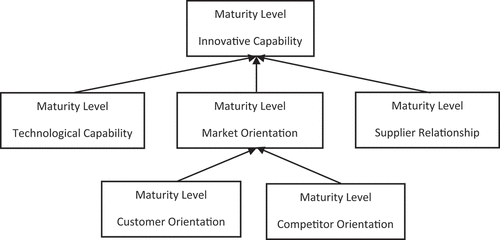
The study conducted an empirical analysis using quantitative research methods to assess the maturity model level in this study. illustrates the maturity model for innovative capability used in this research. Firstly the market orientation maturity model is obtained from the customer and competitor orientation. Next, the innovative capability maturity model is obtained from the market orientation, technology capability, and supplier relationship maturity model. Data is then collected through a survey distributed to respondents from truck-owning companies. The survey uses online questionnaires to collect data, which will be analysed further. The details of each step are described in the following subsections.
Figure 1. Trucking company’s innovative capability maturity model.
3.1. Data collection
The structure of the questionnaire in this study consisted of three parts. The first part contains an introduction, the purpose of the study, guarantees of confidentiality, and brief instructions for filling out the questionnaire. The second section discusses the selection of respondents (name, company name, and title) and demographic information about the companies surveyed (industry sector, number of employees, and average annual sales). Respondents were asked to submit personal data and choose several options for the first and second sections and fill in demographic data.
The third section contains factors that affect the maturity level of trucking companies’ innovative capability, such as the maturity level of technological capabilities, the maturity level of market orientation in which consist of the maturity level of customer and competitor orientation, and the last is the maturity level of the supplier relationship. The previous section has presented the definition of a maturity level to assess the innovative capabilities in trucking companies. There are two answer choices for each question (yes/no), based on whether or not it is done in the company. The questionnaire was adapted based on previous research and is listed in .
This study uses an online self-filling questionnaire. This method is efficient and has a relatively lower cost, and is easier to manage (Kothari, Citation2004 ) compared to other methods. Data collection uses company lists from trucking associations and other sources. An electronic and voice message was then sent inviting the trucking companies to participate in the survey. This questionnaire is answered by positions at the supervisor level and above.
3.2. Sample and data characteristics
The sampling technique ensures that the sample obtained is representative of the population so that the study can be generalised (Forza, Citation2002 ). The population of this research are trucking companies in Indonesia. shows, as many as 72 respondents filled out the online questionnaire, but only 52 (72 percent) of the questionnaires could be used because the company had trucks, and the rest did not (28 percent). The respondents were spanning from supervisor to top management positions. We cluster the 52 companies into those who are (1) purely trucking companies, (2) Distributors who own trucks, (3) Third-party logistics who own trucks, (4) Courier companies who own trucks, (5) Manufacturing companies that own trucks, and (6) Other than 1–5 but own trucks. illustrates the requested demographic data by industry type, the number of trucks, and annual sales.